
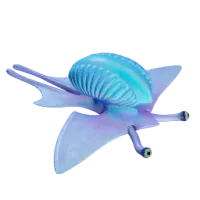
Subnautica 2 Flash Slug Creature Details
Small fauna
Small fauna
Local data status
Classification
Small
Group
Small Creatures
Tags
Herbivore / Small
Databank notes
6
Regions and location notes
No reliable local region list is recorded yet. This page does not convert rumors or unsupported location claims into fixed locations.
Databank entry
Seaslug kleptopharos , the stolen beacon slug. A free-swimming, luminescent relative of the waterslug with chimeric traits from another species entirely.
1. Microbial photocell The flash slug is powered by the same type of microbial fuel cell present in the waterslug. The slug inhales plankton as it swims, which it digests with photodecomposition and feeds to luminescent bacteria that live in coils of glassy fiber deep in its mantle. These fibers generate and direct bioluminescence, and may in fact be biological lasers.
2. Light control The flash slug uses its light to attract food and mates. When threatened, the slug charges up a flash of blinding coherent light to drive off attackers. Spectrogenetic analysis suggests this defense mechanism evolved from a system of internal gene regulation: its original function, millions of years ago, was to activate and deactivate genes inside the slug's body with coded light signals.
3. Raylike body plan The flash slug swims with ray-like wings that grow from its foot. CORRECTION: The first draft of this output incorrectly attributed these wings to genetic sequences transferred from a Protean ray. In fact, the wings are a development of the slug's mantle, like Earth's Spanish dancer. The shared sequences with Protean rays may be related to item 4 below.
4. Enigmatic viral traffic Millihertz variations in the slug's flash patterns appear to be correlated with Proteavirus activity inside the slug's tissues. The flash signals what the virus is doing — but also triggers changes in viral activity in other slugs (and, perhaps, other species that see the flash). It is possible that the flash slug's light displays give the Proteavirus a high-speed data channel.
Assessment: may provide a useful deterrent against predators if gripped. Close eyes to avoid damage.
Native map markers
Flash Slug creature markers for route awareness, biome scouting, and encounter planning on the native map.
Flash Slug sighting 1
X -222742 / Y -184 / Z 426926
Flash Slug sighting 2
X -222742 / Y -210 / Z 448951
Flash Slug sighting 3
X -211360 / Y -263 / Z 409073
Flash Slug sighting 4
X -210143 / Y -253 / Z 409073
Sources and verification
Creature names, classifications, databank counts and region labels come from local creature records. Exact coordinates or habitat claims are omitted when no reliable local record exists.
SN2 Wiki structured creature dataset
Data checked: May 15, 2026