
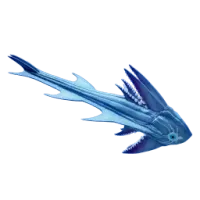
Subnautica 2 Twin Sitaray Creature Details
Large fauna
Large fauna
Local data status
Classification
Large
Group
Large Creatures
Tags
Carnivore / Big
Databank notes
7
Regions and location notes
No reliable local region list is recorded yet. This page does not convert rumors or unsupported location claims into fixed locations.
Databank entry
Sitaroid gemini , the twin ray that resembles a sitar. A dark-sea electropredator driven towards the surface by ecological disruption.
1. Sitar ray Sitar rays, named for their resemblance to Earth's guitarfish, probably diverged from mangos less than 25 million years ago (assuming that models of evolutionary change on Proteus are correct). The flat head contains remnants of a hard shield, similar to Earth's extinct pteraspidomorphs. The jaw has moved beneath the body and rotated. Two spiracles draw water for an internal gill.
2. Deepsea origins The twin sitar is adapted to lightless deep ocean. Its true eyes are buried in a layer of jelly below the skin. The remaining central eye is a hyperdeveloped parietal eye—an organ that tracks light and heat.
3. Twin strategy Like the foureye, the sitar ray is always born in pairs. When mature, the twins split up to pair with mates. Unlike the foureye, the sitar ray has no specialized organ to share food or nerve impulses. The twins clasp mouthparts to exchange food. Communication is electric, similar to Earth's knifefish.
4. Electroactive feeding Channels and ampullae along the sitar ray's body and fins contain electroplaques, modified muscles which generate electric current to stun prey. When separated, twin sitars stay connected by strands of conductive mucus. The longer this connection, the more powerful the dipole of their hunting shock.
5. Shocking behavior Monitor sitar rays for play behavior involving metal debris or constructs.
Assessment: a serious threat to divers and to electrically powered vehicles and bases.
Native map markers
Twin Sitaray creature markers for route awareness, biome scouting, and encounter planning on the native map.
Twin Sitaray sighting 1
X -184737 / Y -234 / Z 467744
Twin Sitaray sighting 2
X -184356 / Y -263 / Z 429341
Twin Sitaray sighting 3
X -181785 / Y -328 / Z 441079
Twin Sitaray sighting 4
X -179105 / Y -263 / Z 454789
Sources and verification
Creature names, classifications, databank counts and region labels come from local creature records. Exact coordinates or habitat claims are omitted when no reliable local record exists.
SN2 Wiki structured creature dataset
Data checked: May 15, 2026