
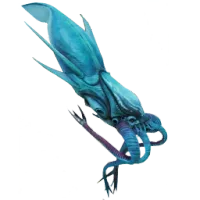
Subnautica 2 Collector Leviathan
Collector Leviathan is the strongest confirmed Leviathan entry in the local dataset. The page focuses on its classification, recorded regions, and why players searching Leviathan routes should treat it as a high-priority threat lookup.
High threat
Local data status
Classification
Leviathan
Group
Leviathans
Tags
Carnivore / Big
Databank notes
8
Regions and location notes
Databank entry
Enormous cephalopod predator (tentatively Tyrannoteuthis phobocoeus , tyrant squid of fearful curiosity). Feeds on hard-shelled, heavily defended prey. Solitary but highly intelligent. Likely a deep-sea creature.
1. Squidlike body plan The collector's body converges with Earth squid — a long mantle and several limbs attached directly to the head. The mantle is covered in plastic armor. Unlike Earth squid, the collector has four long hunting tentacles with dextrous claws. Its eight arms are small and grouped around the beak.
2. Powerful thruster Two large spiracles feed a rear-facing thruster. These spiracles are separate from the four gills openings on the head, allowing the collector to separate its breath rate from its thrust speed. Two secondary hearts pump blood from the gills to the main heart.
3. Hard prey An enormous beak (capable of tearing through plate titanium) and four dextrous tentacles tipped with sharp bioglass claws imply that the collector specializes in prying or tearing open heavily armored prey. Possible prey fauna include the coral crab and great jaw. The need to defeat armored, active prey may have evolved a curious and aggressive psychology.
4. Broadcast organ This huge, many-chambered organ is a biological phased-array sonar. Multiple 'speakers' and 'ears' allow the collector to broadcast complex multi-part pulses. Dense innervation connects this organ to the toroidal brain; patterns of bioluminescence may be direct reflections of the collector's brain activity.
5. W-shaped pupil In bright light the pupil creases into a W. This trait was present in Earth cephalopods, but its function was not determined before the Holocene collapse.
6. Abyssal gigantism Organisms from the deep sea are often very large, a phenomenon known as 'abyssal gigantism'.
Assessment: hunters with varied and difficult diets are likely to be intelligent and inquisitive, and a predator's curiosity may appear to prey as arbitrary torture. Any small submersible or habitat is likely to draw the collector's interest.
Biomods unlocked by scanning

Native map markers
Collector Leviathan creature markers for route awareness, biome scouting, and encounter planning on the native map.
Collector Leviathan sighting 1
X -262494 / Y -145 / Z 440067
Collector Leviathan sighting 2
X -254249 / Y -145 / Z 440067
Collector Leviathan sighting 3
X -245692 / Y -145 / Z 440067
Collector Leviathan sighting 4
X -130059 / Y -289 / Z 387773
Collector Leviathan lookup notes
Why Collector Leviathan comes first
It is one of the strongest local Leviathan records, with region notes and a deep databank entry. Leviathan searches should start here when the player wants confirmed threat context.
How to read the regions
The local record includes CollectorLeviathanRegion plus Overgrown Ruins notes. Treat these as dataset region signals, not a complete spawn-point map.
Where to continue
For route planning, pair this entry with the Leviathan hub, Tadpole route notes, and the map page instead of treating a creature record as a full travel guide.
Sources and verification
Creature names, classifications, databank counts and region labels come from local creature records. Exact coordinates or habitat claims are omitted when no reliable local record exists.
SN2 Wiki structured creature dataset
Data checked: May 15, 2026